


What Are Quadratic Inequalities?
Quadratic inequalities are polynomial inequalities of degree 2. You solve them using sign charts. This is how to do it:
Rule
Solving Quadratic Inequalities
- 1.
- Rearrange the inequality to get 0 is on the right-hand side.
- 2.
- Rearrange the expression on the left-hand side in order of descending degree.
- 3.
- Factorize the expression.
- 4.
- Make a sign chart.
- 5.
- Read off the solution.
Example 1
Solve the inequality
You can factorize this by using the quadratic formula:
Next, you make a sign chart:
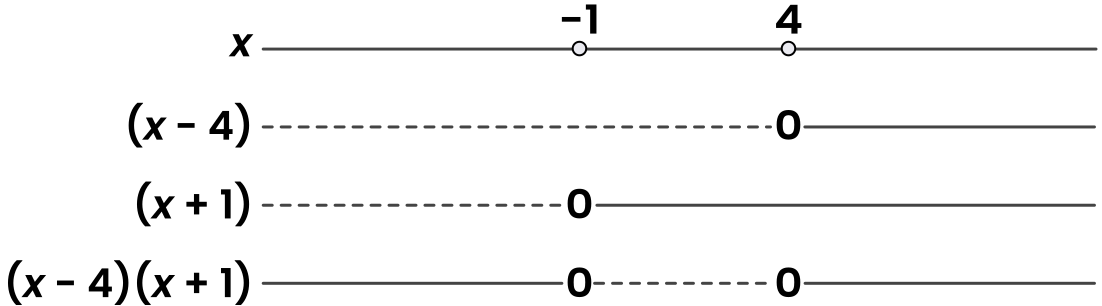
You can read off that when . Because we had a greater than or equal sign () in the original inequality, the intervals are closed on the side that does not tend to infinity.
